
Roller and sectional doors are the two modern choices most Essex homeowners weigh up when an old garage door comes to the end of its life. Both open vertically, both can be insulated and automated, and both are a big step up from a tired up-and-over. Because we only supply roller doors, we have tried extra hard in this guide to give the sectional its due, and there are garages where it is genuinely the better fit.
The mechanical difference is simple. A roller door is a curtain of interlocking aluminium slats that rises vertically and coils around a barrel inside a compact box above the opening. A sectional door is made of four or five large hinged panels that rise vertically, then travel back on horizontal tracks and store flat under the garage ceiling. Everything else in this comparison flows from that one difference.
Space: Where the Roller Door Wins
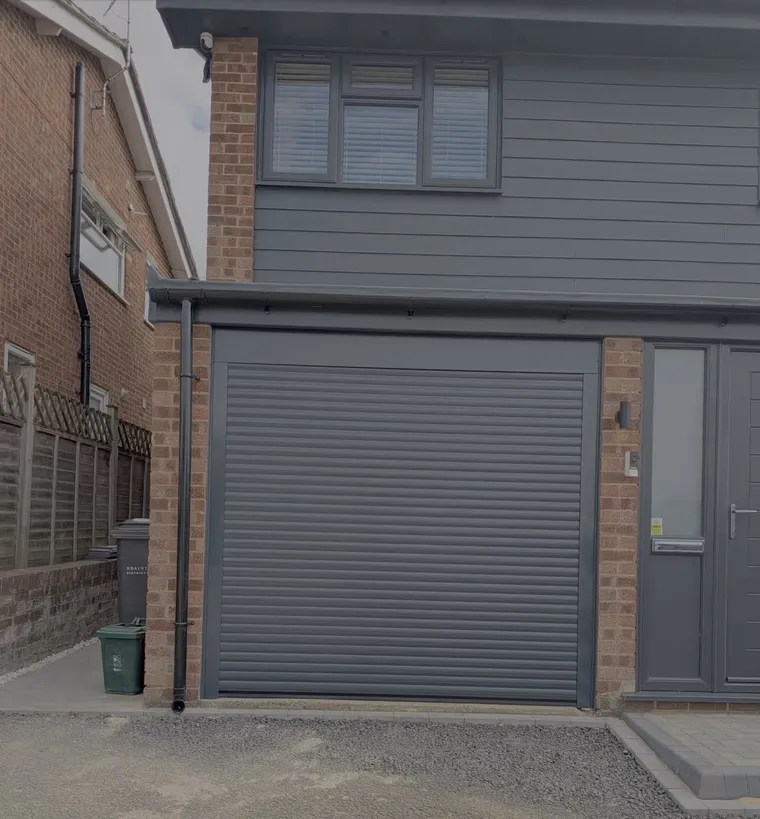
A roller door keeps the whole mechanism at the opening. There are no tracks running back into the garage and nothing suspended overhead, so the ceiling stays completely free for boarded storage, a bike hoist, racking, a loft hatch or decent lighting. The walls beside the opening stay clear too, apart from the slim guide runners the curtain travels in.
A sectional door needs a clear ceiling zone roughly the depth of the door, plus room for the tracks, the springs and the opener rail. In a large detached garage that is often no problem. In the compact single garages we see across much of Essex, that ceiling is usually already doing a job. Plenty of garages in Loughton and the towns nearer London double as a store room, gym or workshop, and giving up the ceiling would mean giving up the ladder rack or the Christmas boxes.
Insulation: Where a Sectional Can Edge It
Here is the point where honesty cuts the other way. Sectional door panels can be made far thicker than any roller slat, so a premium insulated sectional carries more foam across the face of the door than a roller curtain can. If your garage is heated, or you are chasing the very best thermal performance a garage door can offer, a thick-panelled sectional is the stronger tool for that specific job.
That said, a well-specified roller door insulates far better than many people expect. Our slats are aluminium filled with insulating foam: the 55mm profile carries a 12.5mm high-density core, and the 77mm profile uses thicker 18mm insulated slats. For the typical attached garage, that is enough to keep frost off the car, take the chill off an adjoining room and noticeably cut street noise. Panel thickness is not the whole story either: a made-to-measure door that seals properly along its guides and floor line often outperforms a thicker door fitted with gaps.
Not sure which type suits your garage? A free survey gives you an honest answer and a fixed written quote.
Book a Free SurveySecurity: Closer Than You Might Think
Roller doors are hard to attack. The slats interlock along their full width, the door locks automatically every time it closes, anti-lift protection stops the curtain being forced up, and there is no external handle to lever against. That combination is why roller doors have a strong security reputation.
A good sectional is not far behind. The panels sit captive in their tracks, and on an automated sectional the motor itself holds the door shut against being forced. The honest conclusion is that a well-made, properly fitted door of either type is secure, and both leave a worn older door a long way behind. Specification and fitting quality matter more than which type you pick.
Kerb Appeal and Colour Choices
Sectional doors offer the wider range of looks. Because the face is built from large panels, they come in ribbed, smooth and traditional panelled designs, and some can take glazed sections. If you want a garage door with windows, or a period panelled style to match a cottage frontage, that is something a roller door cannot copy.
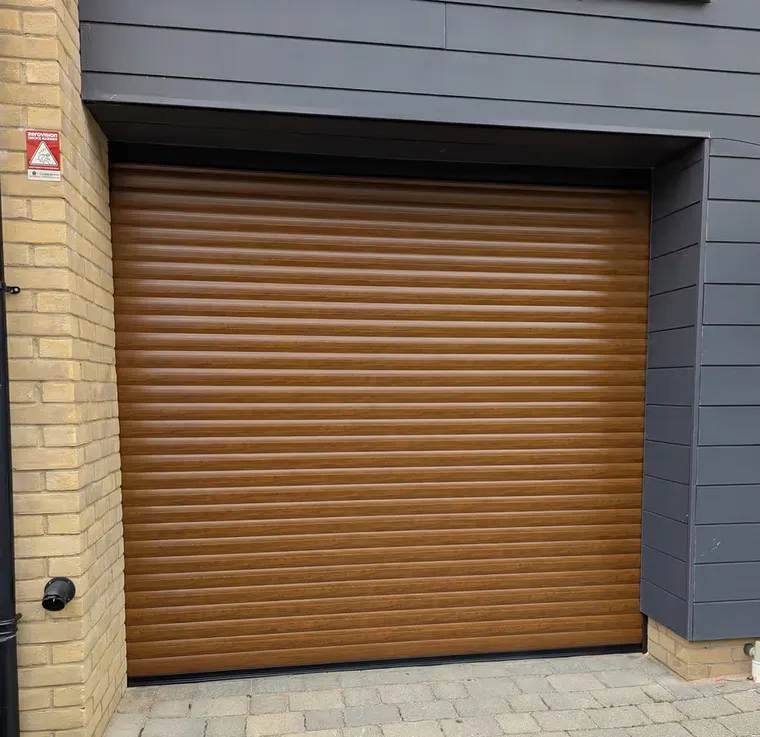
A roller door offers a clean horizontal slat line that suits both modern and older Essex homes, and the colour choice is broad: 16 classic colours, 5 designer colours and woodgrain finishes including golden oak, with the top box and guide runners colour-matched or contrasted to suit. You can browse the full range on our colours page. Neither type has a monopoly on a smart frontage; they simply get there in different styles.
Price and Driveway Length
Like-for-like prices overlap more than the sales brochures suggest. Our made-to-measure electric roller doors typically cost £1,275 to £4,000 installed, and that figure includes the electric motor, two remote controls, a safety edge, automatic locking and a manual override for power cuts. Basic manual sectionals can undercut that, while insulated, automated and glazed sectional designs usually sit at a similar level or above, especially once automation is added as an extra. For a quick idea of where your own garage lands, the garage door cost calculator gives an instant estimate from your measurements.
Driveway length, happily, is a tie. Both types open vertically, so neither swings out across the drive the way an old up-and-over does. If you have a short driveway, or you park close to the door, either type works. The differences that matter are all inside the garage.
Roller vs Sectional at a Glance
| Feature | Roller door | Sectional door |
|---|---|---|
| How it opens | Curtain coils into a compact box above the opening | Panels rise, then slide back on tracks under the ceiling |
| Ceiling space needed | None; the ceiling stays free for storage and lighting | A clear ceiling run for tracks, panels and the opener |
| Insulation | Foam-filled aluminium slats; insulates well for most garages | Panels can be thicker, so the top insulation spec is higher |
| Security | Interlocking slats, automatic locking, anti-lift protection | Secure when well specified; the motor holds the door shut |
| Kerb appeal | Clean slat line, wide colour range, woodgrain finishes | Panelled, ribbed and glazed designs; the wider style range |
| Short driveways | Opens vertically; park right up to the door | Opens vertically; equally good on a short drive |
| Typical price position | £1,275 to £4,000 installed, automation included | Overlapping range; premium and glazed designs cost more |
Which Door Suits Your Essex Garage?
For most Essex homes the roller door is the practical choice: many garages here have limited ceiling space, and plenty are used for storage, a workshop or a home gym as much as for the car. A roller door protects all of that space while still giving you an insulated, automated, secure door. A sectional earns its place where the garage has a clear, generous ceiling and the priority is the maximum panel insulation available, particularly in a heated garage.
If the roller route looks right for your home, our roller garage door installation page explains the full process: free survey, fixed written quote, made-to-measure manufacturing and an installation usually completed within half a day. And if the survey tells us your garage is the exception that suits a sectional, we will tell you that too. An honest recommendation costs us nothing and saves you fitting the wrong door.